Most buyers walking into a waterfront purchase in Panama City's Cove neighborhood plan for the inspection everyone talks about: a licensed inspector climbing into the attic, testing outlets, checking the water heater. That inspection matters. But it is not the one that actually stalls closings on Bunkers Cove Road or along Massalina Bayou. The paperwork that catches buyers off guard lives in a different filing cabinet entirely, one that covers the dock at the end of the yard, the seawall holding the bank in place, and the flood elevation number stamped on a survey that may already be out of date.
The Cove earns its reputation honestly. It sits along St. Andrews Bay, framed by Bunkers Cove, Massalina Bayou, and Watson Bayou, with historic cottages and craftsman homes mixed among larger waterfront estates just minutes from downtown Panama City. Joe Moody Harris Park and Massalina Bayou Park give the neighborhood its public waterfront breathing room, and the mature trees and longer-developed lots along its streets are part of what makes a Cove listing feel different from a subdivision lot ten minutes inland. That water frontage is the draw. It is also where the second paper trail begins.
Two systems, and only one shows up on a standard inspection report
A conventional home inspection and a four-point insurance inspection cover the roof, electrical panel, plumbing, and HVAC. Neither one touches the dock, the seawall, or the flood compliance history of the lot itself. Those live under a completely separate set of rules administered by Bay County and, within city limits, by the City of Panama City's Development Services Department.
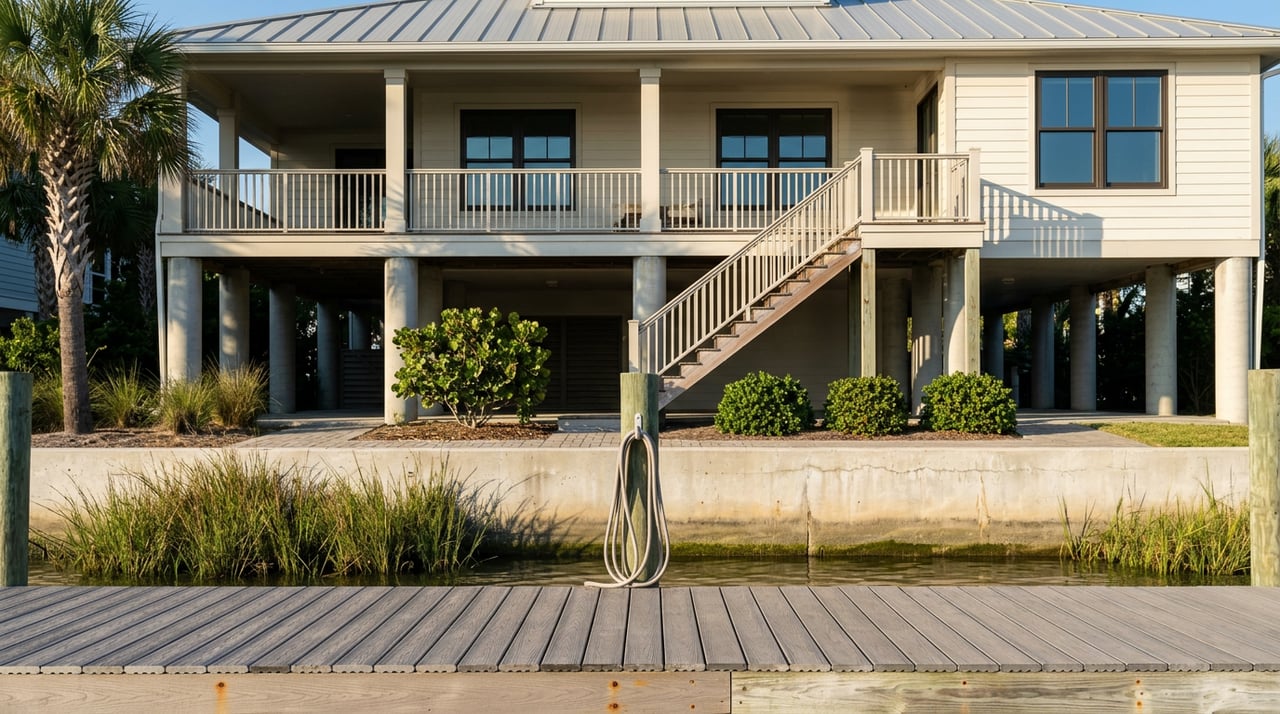
Bay County requires a permit for any new construction, structural change, or repair to a private dock or seawall. That permit history is public record, and it matters at closing because missing or incomplete documentation on shoreline work can create delays or unexpected costs for a buyer who assumed the dock came with a clean paper trail. Inside city limits, dock and boat structure projects go through a formal development order review at City Hall on Harrison Avenue, one that requires a copy of the deed, a tree removal permit if applicable, and a signed agent authorization form before the county or state will even look at the application. A weathered pier that looks like a simple do-it-yourself repair from the seller's last summer project may, on paper, be an unpermitted structure that a title company or lender flags during due diligence.
Rebuilt after Michael doesn't automatically mean permitted after Michael
Hurricane Michael made landfall in 2018 and left a visible mark on wind performance expectations across Bay County. A meaningful share of Cove housing stock has been rebuilt or substantially repaired since then, and that history is generally a selling point: newer roofs, updated opening protection, tie-downs installed to current code. The detail worth checking before writing an offer is whether that visible work was actually permitted and closed out with a final inspection, not just completed by a contractor after the storm. A roof that looks new and a roof that has a permit on file with a passed final inspection are not always the same roof, and only one of them holds up cleanly when an insurance underwriter or a future buyer's inspector starts asking questions.
The 50 percent threshold that punishes the exact renovation buyers want to do
Here is the part of Cove ownership that generic homeownership guides never mention, because it only matters in a flood zone next to a bay. Communities that participate in the National Flood Insurance Program, and Bay County is one of them, apply a standard known informally as the substantial improvement rule. If the cost of renovating an existing structure reaches roughly half of the home's market value within a set window of time, the building code treats that renovation as new construction, which means the home may need to be elevated to meet current flood standards before the work can be finished.
That rule collides directly with what makes Cove real estate appealing in the first place. The neighborhood's identity rests on older cottages with real bones and real history, the kind of property a buyer looks at and immediately starts pricing out a kitchen gut, a primary suite addition, maybe a full second story. Bay County's own guidance on flood zone construction notes that additions to existing homes in flood zones fall under their own set of applicable rules, and that homeowners planning larger renovations should check in with staff before assuming a project is a simple remodel. A buyer who falls in love with a Cove fixer-upper for its price-per-square-foot needs to run that renovation budget against the home's value before committing to a scope of work, because crossing that threshold turns a cosmetic project into a foundation-level one.
The flood map moved. Your elevation certificate might not have.
FEMA adopted new flood zone maps for Bay County in 2024, and the change expanded several AE zones and introduced new moderate-risk X500 designations in areas of Panama City that hadn't previously carried them, including neighborhoods near Gulf Coast State College. That update is still the map in effect today, which means any elevation certificate written before 2024 was answering a question the county is no longer asking the same way. Bay County's own building standards require the lowest floor of a home in an A or V flood zone to sit at least one foot above the base flood elevation, verified by a surveyor-prepared elevation certificate both during construction and again once the floor is finished, before the city will issue a certificate of occupancy.
The practical takeaway for a Cove buyer is straightforward: an elevation certificate that was accurate the year it was issued does not automatically reflect where the property sits on the current map. Anyone under contract on Cove waterfront should pull the property's current flood zone and base flood elevation directly through the City of Panama City's own property lookup tool rather than relying on a certificate from a prior sale. It is a five-minute check that answers a question a standard inspection never asks.
| Standard four-point inspection | Waterfront paper trail | |
|---|---|---|
| Covers | Roof, electrical, plumbing, HVAC | Dock/seawall permits, flood zone status, elevation certificates |
| Who requires it | Insurance carrier | Bay County, City of Panama City, FEMA/NFIP |
| Where it lives | Licensed inspector's report | County and city permit records, property flood lookup |
| When it matters | Every closing | Waterfront lots, older homes, renovation plans |
One more disclosure tied to the neighborhood's age
Many Cove homes predate 1978, which means federal lead-based paint disclosure requirements apply at the time of sale. It is a standard form, not a dealbreaker, but it belongs on the same pre-closing checklist as the permit and flood records, especially for a buyer planning renovation work that could disturb original paint or plaster.
What this means if you're the one signing the contract
None of this makes Cove waterfront a harder buy than it looks on the listing photos. It makes it a buy that rewards a slower, more deliberate first thirty days. Before an offer goes in, a buyer's agent who knows this neighborhood should be pulling dock and seawall permit history from the county, confirming the property's current flood zone and base flood elevation through the city's own lookup tool, and asking directly whether any post-storm rebuild work was permitted and finaled rather than simply completed. For sellers, having that file assembled before listing, permits, elevation certificates, and any post-Michael inspection sign-offs, shortens the path to a clean closing and heads off a renegotiation that shows up two weeks before the scheduled date.
Bunkers Cove sale prices moved higher over the three months ending in June 2026 compared with the same stretch a year earlier, and homes in the area were closing faster than they had the year before that. A market moving that quickly rewards the buyer and seller who already have the paperwork in hand, not the ones assembling it after the fact.
If you're weighing a purchase or a sale in The Cove, The Gene Team works Bay and Walton counties daily and can help you get ahead of the permit and flood-zone questions before they become closing delays. Explore current listings on our Panama City neighborhood page, or if you're weighing whether now is the time to list a Cove waterfront property, start with a free home valuation and we'll walk you through what your file needs before it hits the market.
A few questions worth asking before you write an offer
Does every dock in The Cove need its own permit? Any new dock, and any structural repair or change to an existing dock or seawall, requires a permit through Bay County or the City of Panama City depending on location. A dock that predates current owners may still lack closed-out paperwork, so ask for permit records and as-built plans rather than assuming age equals approval.
How do I check a property's flood zone before making an offer? The City of Panama City maintains a property lookup tool that returns flood zone, base flood elevation, and design flood elevation by address. Check it directly rather than relying on a prior owner's elevation certificate, since the underlying flood maps have changed.
What happens if a renovation crosses the 50 percent threshold? Once a renovation's cost reaches roughly half the home's market value within the applicable window, current flood code treatment kicks in and the structure may need to be elevated as part of the project. Get a realistic renovation estimate and a current property valuation before finalizing scope, not after.